
New benchmark data reveals that financial services marketers who judge LinkedIn performance in monthly increments are systematically undervaluing the channel now delivering the strongest ROI in B2B paid media.
The question that dominates every B2B marketing budget review is predictably blunt:
“ We spent money on LinkedIn last month. What revenue did it generate? ”
It is a fair question. It is also the wrong one.
New benchmark data from Dreamdata, drawn from over 66 million sessions across 3.5 million B2B customer journeys, reveals a picture that should reframe how financial services
marketers think about channel allocation, attribution, and the sales cycle itself.
The 2026 LinkedIn Ads Benchmarks Report makes the case clearly. Understanding what it says and what it means for B2B financial services marketing strategy – should be a priority for
every marketer planning budgets for the year ahead.
The B2B buyer journey has fundamentally changed.
The most striking headline from this report is not a platform metric. It is a behavioural one.
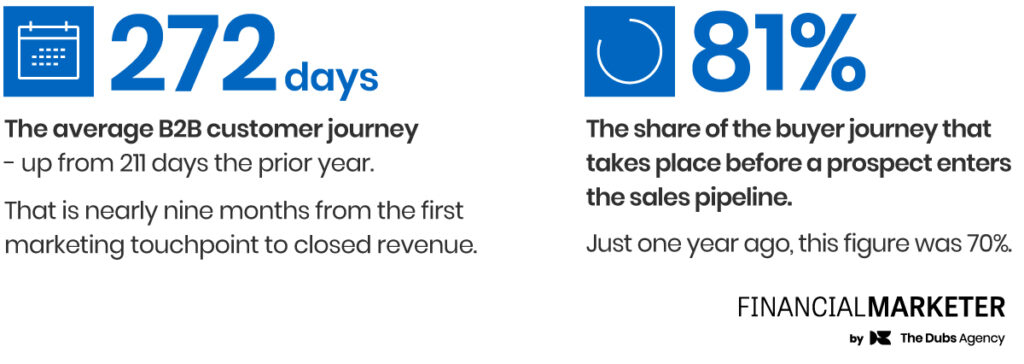
That 11-point shift in a single year signals something significant. B2B buyers are doing more of their research, education, and internal alignment independently and marketing is responsible for shaping that process long before sales is ever involved.
For financial services firms, this dynamic is particularly pronounced. Complex products, high-value decisions, compliance considerations, and multi-stakeholder approval processes mean
buyers in wealth management, asset management, funds administration, and financial
technology routinely require extended evaluation periods. The data confirms what experienced financial marketers already know intuitively: trust is built long before a demo is booked.
What the data adds is precision.
The buying committee is growing, and so is the complexity.
Between 2024 and 2025, the B2B buying journey did not just get longer, it got more crowded.
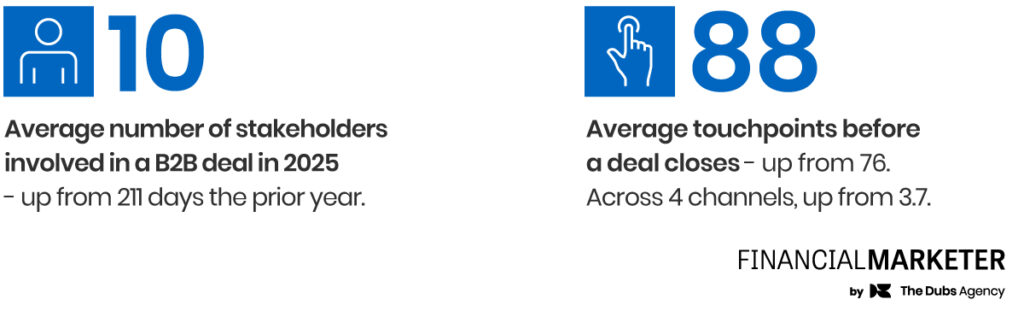
For financial services firms selling to institutional clients, fund managers, or enterprise finance teams, buying committees of this size are standard. The implication is direct: marketing that
targets a single contact is no longer sufficient. The entire buying group must be reached and influenced over time.
This is where LinkedIn’s structural advantage becomes quantifiable.
LinkedIn is the only ad platform delivering positive B2B ROAS.
The report’s financial data cuts through the noise on channel performance.
| Platform | ROAS 2024 | ROAS 2025 | Trend |
|---|---|---|---|
| 113% | 121% | ↑ Only positive ROAS | |
| Google Search | 78% | 67% | ↓ Declining |
| Meta | 29% | 51% | 51% ↑ Still sub-breakeven |
Among top-performing advertisers, LinkedIn’s advantage is even more pronounced – reaching 279% ROAS, compared to 138% for Google Search and 133% for Meta.
At the company level, the metric that actually matters in B2B – cost per company influenced on LinkedIn dropped from €154 to €70.11 over the year, a fall of more than 54%. On Google Search the equivalent figure was €110.37, and on Meta €128.70.
“ The catch and it matters – is that cost per contact influenced on LinkedIn rose sharply to €1,033.29. This is the figure that makes CMOs flinch. But this is also where the traditional B2C lens misleads B2B marketers. You are not trying to influence one contact. You are trying to influence the entire buying committee. At €70 per company, that is highly efficient.”
The problem with how most financial marketers measure performance.
The report identifies a systemic measurement failure that is especially costly in financial services.
Most marketing teams and most reporting platforms, are still measuring performance using metrics designed for B2C buying behaviour: cost per click, click-through rate, cost per lead, and
monthly conversion numbers. These metrics made sense when a single buyer made a fast decision after clicking an ad. They do not reflect B2B reality.
CPC tells you what you paid for a click. CTR tells you how many people clicked. Neither tells you whether you influenced the right company, reached the full buying committee, or contributed to a deal that closes seven months from now.
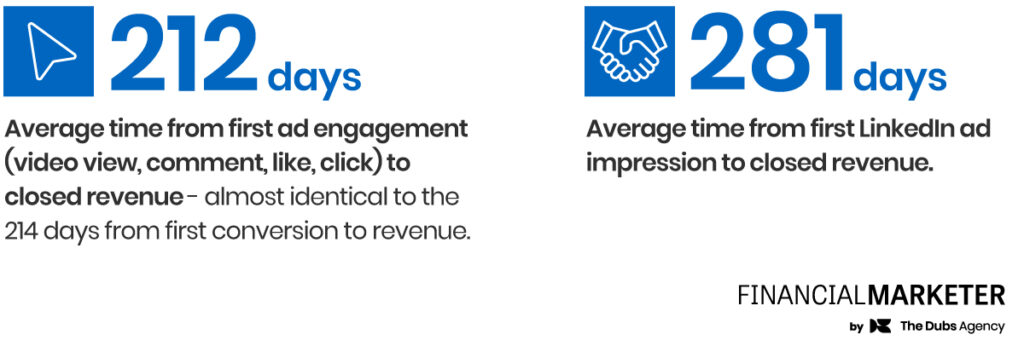
The implication is direct: a buyer who watches your video or comments on your thought leadership post is just as early in their decision-making journey as a buyer who fills out a form. Financial marketers who count only conversions are missing the majority of meaningful intent signals in their pipeline.
Where budgets are shifting and what it reveals.
LinkedIn now accounts for 41% of total B2B paid social ad spend among businesses in the Dreamdata dataset, the single largest individual channel, up from 39% the previous year.
More notable is where budgets are contracting. Non-branded Google Search has dropped from 37% to 33% of total spend. The reason is economics, not strategy.
Non-branded Google Search CPCs rose 29% year-on-year, while click-through rates fell 26%. AI-driven zero-click results are intercepting buyer queries before users reach brand websites, eroding the efficiency that once justified the spend. For financial services firms that have historically relied on category search terms “best managed fund” or “top superannuation provider” the deteriorating economics of non-branded search are a structural challenge, not a temporary fluctuation.
The budget is moving because the return is moving.
What LinkedIn’s full-funnel data reveals about strategy.
One of the most practically significant findings concerns where in the funnel LinkedIn Ads are having impact.
In the previous year’s report, LinkedIn’s influence was concentrated at the MQL (marketing qualified lead) stage. This year, a more mature pattern has emerged:
| Funnel stage | LinkedIn Ads Share 2024 | LinkedIn Ads Share 2025 |
|---|---|---|
| MQL | 30% | 24.2% |
| SQL | 28% | 30.2% |
| New Business | 15% | 28.3% |
Unlike the previous year, LinkedIn’s influence is not declining as prospects move deeper into the funnel, it is growing. Buyers are still engaging with LinkedIn content after they have entered sales conversations, reinforcing brand presence during the evaluation and shortlisting phase.
For financial services marketers, this has a direct implication. LinkedIn is no longer a top-of-funnel demand generation tool. It is a full-funnel platform capable of influencing procurement decisions at every stage – including during competitive tender processes when institutional buyers are narrowing their options.
Five strategic priorities for B2B financial services marketers.
The data points clearly to where the highest-return investments lie.
1. Shift measurement from contacts to companies.
The single most important change a financial services marketing team can make is to adopt company-level measurement. Cost per company influenced, pipeline influence by account, and revenue attribution at the firm level are the metrics that reflect how B2B buying actually works. Platforms that enable this – including LinkedIn’s own Campaign Manager with account-based tracking, and attribution tools that map the full customer journey – should be evaluated and implemented.
2. Invest in demand creation, not just demand capture.
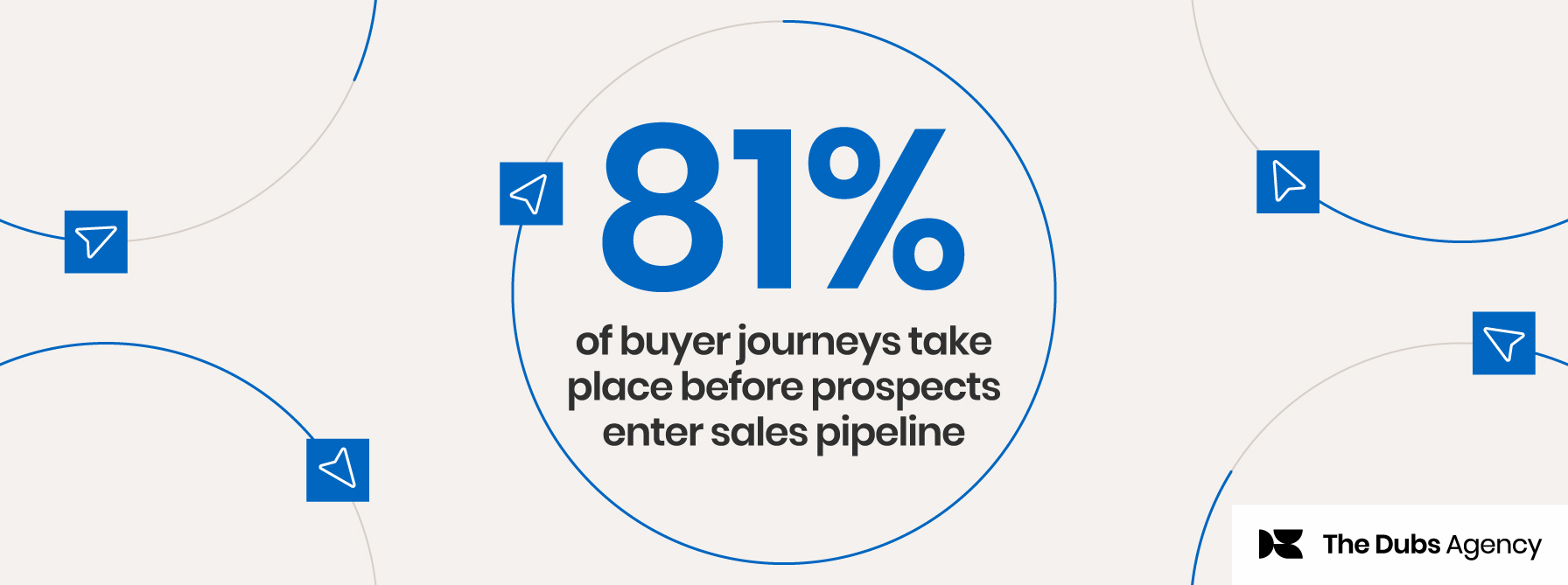
With 81% of the buyer journey happening before a prospect enters a sales pipeline, financial services marketers cannot afford to be invisible during the early research phase. This means sustained investment in LinkedIn content that educates, challenges assumptions, and builds category authority – not just retargeting campaigns that chase people who already know your brand.
3. Build thought leadership as a systematic asset.
LinkedIn rewards people-led content, not polished corporate advertising. For financial services firms, this means amplifying the voices of portfolio managers, investment directors, chief economists, and client advisers through thought leadership ads. When an expert’s post consistently appears in the feeds of institutional buyers over several months, it builds the kind of trust that accelerates consideration when a buying window opens.
4. Reconsider non-branded Google Search allocations.
With CPCs up 29% and CTRs down 26%, the economics of non-branded Google Search are deteriorating. For financial services firms, the smarter allocation for category awareness is now LinkedIn, where company-level ROAS is demonstrably superior and the targeting precision – by firm type, AUM, seniority, geography is unmatched. This does not mean exiting Google. It means auditing the budget split and redirecting spend toward the channels delivering stronger pipeline influence.
5. Design campaigns for a non-linear buyer experience.
Financial services buyers are not moving through a neat funnel. They are researching across multiple channels, consulting multiple stakeholders, and engaging with content in short, non- sequential bursts over months. Campaigns built around sequential storytelling – Ad A, then Ad B, then Ad C consistently underperform because they assume buyer behaviour that does not
exist.
A more effective approach is to run parallel ad types that each stand alone: educational content that teaches, diagnostic content that names a problem, proof-driven content that demonstrates
outcomes, and commercial content that prompts action. Let frequency and relevance do the compounding work over time.
The implication for financial services marketing leadership.
The 272-day customer journey is not a problem to be solved. It is a reality to be planned for. Financial services firms that accept this reality and build marketing infrastructure to stay visible, credible, and relevant throughout that entire window, will have a compounding advantage over competitors still optimising for last-click attribution and monthly lead counts.
The data is clear on where that infrastructure should be built. LinkedIn delivers the strongest ROAS of any major B2B ad platform. Its influence is growing at every stage of the funnel. Its company-level targeting is structurally better suited to B2B buying behaviour than any alternative.
If you liked this article and want to know more contact The Dubs Agency we’d love to help.
Source: Dreamdata, LinkedIn Ads Benchmarks Report 2026. Data drawn from aggregated campaign data from thousands of Dreamdata customers covering 66+ million sessions across 3.5+ million B2B customer journeys. Full report available at dreamdata.io.